Historias Sin Fronteras

  • portada 01

  • Portada 02

    Sweet Salinity

  • Portada 03

    Mangroves

  • Portada 04

    Conservation

  • Portada 05

    Honey

  • Portada 06

    Central America

Sweet Salinity Conservation Buzzing in the Mangroves


In El Salvador and Costa Rica, coastal communities are transforming degraded wetlands into sustainable apiaries. Despite the success of the restoration, they face the climate crisis, illegal fires and a financial crossroads: how to survive without external funding.


By: Jorge Rodríguez & Michelle Soto

For the ancient Maya, mangroves were more than just the boundary between land and sea. From mangroves, they obtained food, wood and salt. The peaceful channels functioned as commercial routes connecting different regions of Mesoamerica. Even stingless bees held a special place in that world: the Madrid Codex documents beekeeping practices, and the god Ah Muzen Cab was revered as the protector of honey and its keepers.

More than a thousand years later, Central American mangrove forests continue to be a source of life and livelihood for thousands of coastal families. But unlike their ancestors, today’s inhabitants face threats such as climate change, agricultural expansion, pollution and unplanned coastal development. Fishing is no longer enough to provide for the communities, which has led bees to regain a leading role that had long been forgotten. Honey production has become a venture that proves that conserving mangroves can also support sustainable livelihoods.


Mangrove Coverage in Central America

Regional Total: 494.624


Mangroves represent approximately 2% of the forest cover -- just under 1.2 million acres -- in Central America. While that percentage might seem small, each acre of mangrove captures up to four times more carbon than an acre of tropical rainforest.

But this ecological importance has not been enough to protect them. For decades, Central American mangroves have lost ground to agricultural expansion, coastal development, pollution and climate change. In countries like Guatemala, El Salvador and Costa Rica, sugarcane farming has reduced mangrove coverage and disrupted hydrological connectivity by diverting rivers. In other areas, cutting trees for firewood and charcoal continues to degrade these ecosystems.


ManglaresThreats

ManglaresThreats

ManglaresThreats

ManglaresThreats

ManglaresSuperpowers:

Mangroves: The Ecosystem Connecting Land and Sea

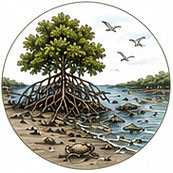
This forest has no visible floor. Instead, it rises on an architecture of intertwined roots, as if the trees were walking on stilts over the sea.

Hectareas

494.624

Mangrove hectares in Central America

Hectareas

10-14

Mangrove species

Hectareas

4

Species account for nearly 90% of the isthmus's mangrove coverage

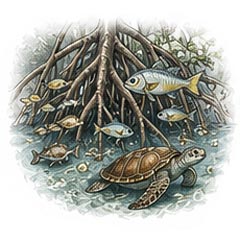
Beyond the capacity to store carbon, mangroves function as true marine nurseries. Among their roots grow the early life stages of red snappers, grouper and even some shark species. There, mollusks, crustaceans and hundreds of organisms also find refuge, which both commercial fishing and the food security of thousands of coastal families depend on.

Manglares

Serve as ocean nurseries, sheltering marine species during their growth stages.

Manglares

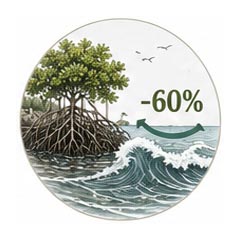
Reduce wave force by up to 60%.

Manglares

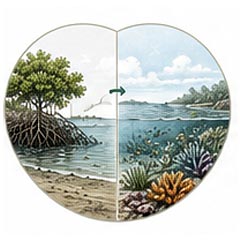
Block erosion and agrochemicals from reaching coral reefs and seagrass beds.

Manglares

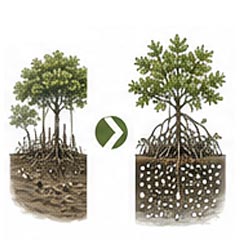
Store up to 5 times more carbon than terrestrial forests, primarily in the soil.

Manglares

Urban and agricultural expansion.

Manglares

Firewood extraction.

Manglares

Pollution.

Manglares

Sea-level rise.

Source: FAO, CCAD & IPCC

Mangrove species present in all Central American countries:

Red mangrove
(Rhizophora mangle)

White mangrove
(Laguncularia racemosa)
Black mangrove
(Avicennia germinans)
Buttonwood mangrove
(Conocarpus erectus)

Climate change adds another threat. In the Costa Rican Pacific, the rising water temperature affects the survival of red mangrove seedlings, or propagules. In different areas of the isthmus, more intense rains carry debris and sediment that alter the dynamics of these mangrove forests. Furthermore, ghost nets, fires and other pressures force people to rethink the way they coexist with the mangrove.

Roughly 90% of the world's mangroves are located in developing countries, where environmental pressures from human activity advance rapidly and without control. However, in recent years, a culture of restoration has become part of coastal communities. The presence of different projects driven by international cooperation and, in some cases, government support, have introduced a variety of techniques aimed at restoring mangrove health. Nevertheless, in most communities, restoration is voluntary.

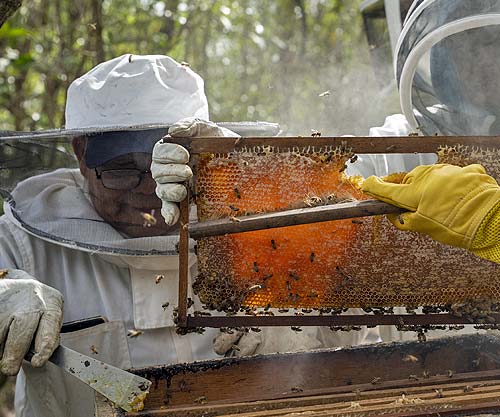
The next challenge is to transform this effort into sustainable livelihoods for the communities. Honey production is an innovative alternative with many possibilities. In Costa Rica, a community-based project known as ApiMangle demonstrated how hydrological restoration accelerated the return of native flora, populating the landscape with mangrove trees that today feed hives raised over the water. Chemical analyses reveal a unique honey, with 30% mangrove pollen and a high concentration of minerals due to the brackish nectar.

Mangrove Restoration in Central America

Mangrove restoration in Central America has evolved from isolated "tree-planting" efforts to a highly complex, community-driven scientific discipline.

While mangrove restoration in the region dates back 30 years, the pivotal transition occurred roughly 15 years ago. It was then that practitioners realized that restoring a mangrove means, above all, restoring its hydrological dynamics.


  • 1988-1999

    1988-1999

    Reforestation trials: Mangrove planting

  • 2000-2015

    2000-2015

    Emergence of Ecological Mangrove Restoration (EMR). Rather than just introducing plants, efforts shifted toward hydrological rehabilitation.

  • 2015-2026

    2015-2026

    The blue carbon boom and community engagement.


EMR Approach

Popularized by Latin American scientists, Ecological Mangrove Restoration (EMR) consists of five steps prior to 'touching the mud':


  • 01

    manglares Understand local ecology.

  • 02

    manglares Map historical hydrological patterns (how water used to flow).
  • 03

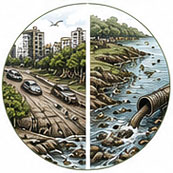
    manglares Identify disturbances (what killed the mangrove: a road, sedimentation, or pollution?).
  • 04

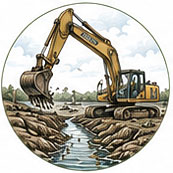
    manglares Address hydrological disturbances first (by clearing or opening channels).
  • 05

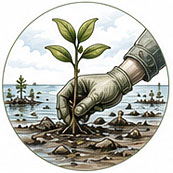
    manglares Plant only if necessary. In over 70% of cases, once water dynamics are restored, the mangrove reseeds itself.
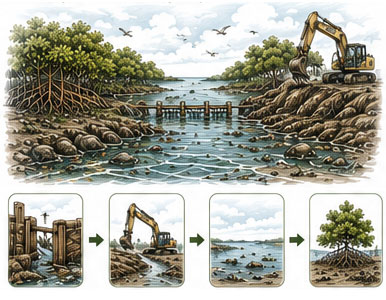
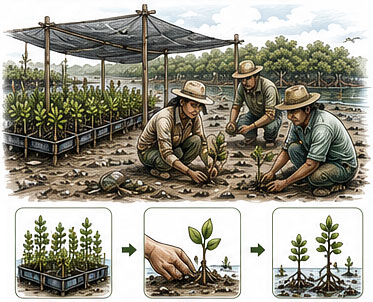
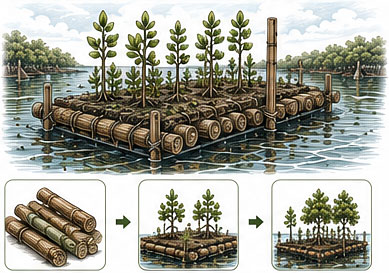
3 Restoration Techniques Used in Central America:

Involves clearing and opening channels to restore tidal inflow, resetting topography, and removing artificial barriers—such as breaching dikes from old salt flats or shrimp farms—to reconnect the wetland with the sea or estuary. Once water flow is restored, propagules (mangrove seedlings) disperse and arrive on their own.manglares

When an ecosystem is too degraded or isolated for channel clearing alone, human intervention becomes necessary. This includes removing invasive species and cultivating propagules in community nurseries until they develop strong roots. The seeds are then planted directly during low tide.manglares

Inspired by the pre-Hispanic floating agricultural system of the Valley of Mexico, chinampas are small artificial islets constructed from wood, bamboo and other organic materials. They serve as platforms that support the organic substrate and mechanically protect early seedling development. This technique is deployed when the mud is too unstable or when tidal dynamics threaten to sweep seeds away before they can take root.manglares


The Community Factor: None of these techniques succeed over the long term without community leadership. Local knowledge determines where historic tidal channels run and the exact time of year to clear or plant.


SOURCE: Conservación Internacional and CCAD.


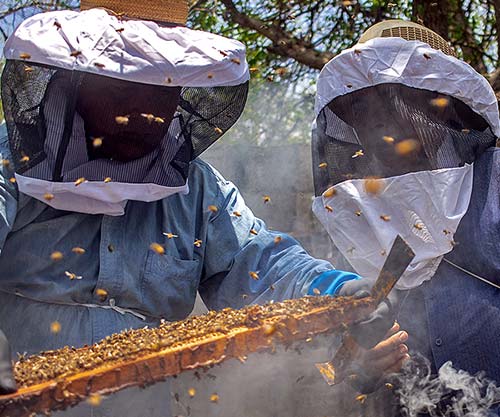
In El Salvador, the community of El Mango experienced a similar turning point. After clearing acres of mangrove forest through sheer willpower, residents discovered a flowering so rich that it multiplied their hives, allowing them to gain an intimate understanding of the bee cycle. But climate variability and the withdrawal of international funding have forced them to adapt once more and find a way to sustain a beneficial activity that does not damage the mangroves.

Communities in Costa Rica and El Salvador have proved that mangroves can be restored. Their challenge is finding a formula to build fair local markets that replace international subsidies.

A millennium after the ancient Maya navigated these waters, the fate of Central America's mangrove forests is once again intertwined with that of bees. In this ecological relationship, sweet, brackish honey ceases to be just a unique product of biodiversity and becomes the symbol of a coastal economy that continues to persevere, sweetening the future of an ecosystem vital to the planet.

A Mangrove Forest Flowing with Honey

Although mangroves are predominantly wind-pollinated, the presence of bees increases seed production, accelerating natural regeneration.


Types of Honey-Producing Bees in Central America:

  • manglares

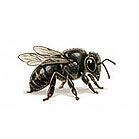
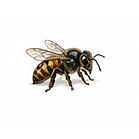
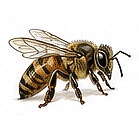
    Africanized Honey Bee

    (Apis mellifera): A hybrid of European and African bees

  • abejas Production:

    High (7.5–15 gallons / 28–56 liters per hive/year)

  • Management:

    Requires protective suit, smoker, and hive stands

  • Ecological Niche:

    Generalist

  • Honey Use:

    Food source / Export


  • abejas

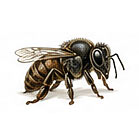
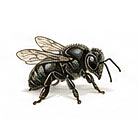
    Melipona Bees

    (Stingless): Native.

  • abejas Production:

    Low (0.25–0.5 gallons / 1–2 liters per hive/year).

  • Management:

    Can be managed without protection.

  • Ecological Niche:

    Specialist (pollinates specific native plants).

  • Honey Use:

    Medicinal / gourmet / ritual.

  • abejas Abeja real
    (Melipona beecheii):

    Sacred to the Maya due to its medicinal properties.

  • abejas Mariola / Angelita / Doncellita
    (Tetragonisca angustula):

    Exceptionally small bees whose honey is famous for treating vision problems, such as cataracts and pterygium.

  • abejas Soncuano / Pizco / Enreda-pelo
    (Scaptotrigona pectoralis)::

    Highly active pollinators.


Therapeutic Benefits of Mangrove Honey

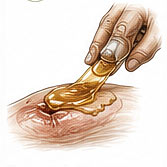
Its antiseptic properties accelerate tissue repair.

manglares

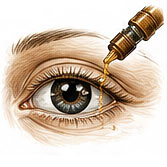
Honey from native bees (such as the Mariola) is highly prized for treating vision issues like cataracts and pterygium.

manglares

Due to marine influence, it contains high levels of minerals and antioxidants that strengthen the body's defenses.

manglares

Its viscosity and chemical composition effectively soothe coughs, asthma, and throat inflammation.

manglares


Mangrove honey is more than a culinary and therapeutic choice—it directly supports the conservation of living barriers against climate change..


SOURCE: CINAT-UNA, Apimangle and Entre Manglares.

El Salvador
EL SALVADOR

Mangrove Honey: Salvadoran Fishermen Bet on Making a Living from Restoration


Costa Rica
COSTA RICA

Puntarenas Mangrove Rewards Ecological Restoration with Honey